
Fitted Wardrobes in London
Fitted wardrobes in London period properties present a specific set of challenges. Victorian and Edwardian bedrooms have alcoves of variable depth and width, sloping ceilings on top floors, chimney breasts that interrupt runs of storage, and original coving and skirting that cannot simply be removed to make way for a flat-pack unit. AMB Joinery designs and builds bespoke fitted wardrobes across London — made specifically for the room, designed around the original details, and built to last.
We do not supply modular wardrobe systems.


.webp)
Why Bespoke Matters for London Bedrooms
The most common wardrobe brief in London is alcove wardrobes — fitted into the chimney-breast recesses that appear in almost every Victorian and Edwardian bedroom. These alcoves are rarely the same width on both sides, often vary in depth from top to bottom, and frequently have skirting boards, dado rails or picture rails that would need to be removed for a standard wardrobe carcass to fit.
Bespoke joinery works around all of this. The carcass is made to the exact internal dimensions of the alcove, the cornice and plinth details are designed to match the existing room joinery, and the skirting and dado rail are incorporated into the design rather than cut out. The result is a wardrobe that appears to have always been part of the room — which, done well, is the correct outcome.
The same principle applies to under-stair storage, top-floor rooms with sloping ceilings, landing storage and any other space where the geometry of the room makes a standard unit impractical.
Design
Space Planning
We start with a measured survey of the room — including every dimension of the alcove or wall, the height at multiple points (particularly important in rooms with cornices or sloping ceilings), the skirting and dado rail heights, and the position of any electrical outlets or radiators that need to be worked around.
From the survey, we produce a detailed drawing of the proposed wardrobe, showing the interior layout — hanging space, shelving, drawers — as well as the external elevations, door configuration and how the joinery meets the existing room details.
Interior Configuration
We design the interior storage around what needs to be stored. Standard configurations include:
- Full-height hanging for long dresses and coats
- Double hanging (two rows of shorter rails for suits and shirts)
- Mixed hanging and shelving
- Drawer stacks integrated into the carcass
- Pull-out trouser racks, tie rails and accessory drawers
The interior is configured per section — alcoves on either side of a chimney breast often have different proportions and are used differently. We design each section to its specific use.
Door Style
Hinged doors — traditional, reliable, no track required. The door swings out into the room; requires clearance in front. The most common choice for wardrobes in period rooms where a furniture aesthetic is the brief.
Sliding doors — panels slide on a top-hung track (track in the floor is not used in our installations, as it collects dust and interferes with flooring). Sliding doors do not require clearance but access at any one time is limited to the width of one panel. Suited to rooms where the clearance for hinged doors is not available.
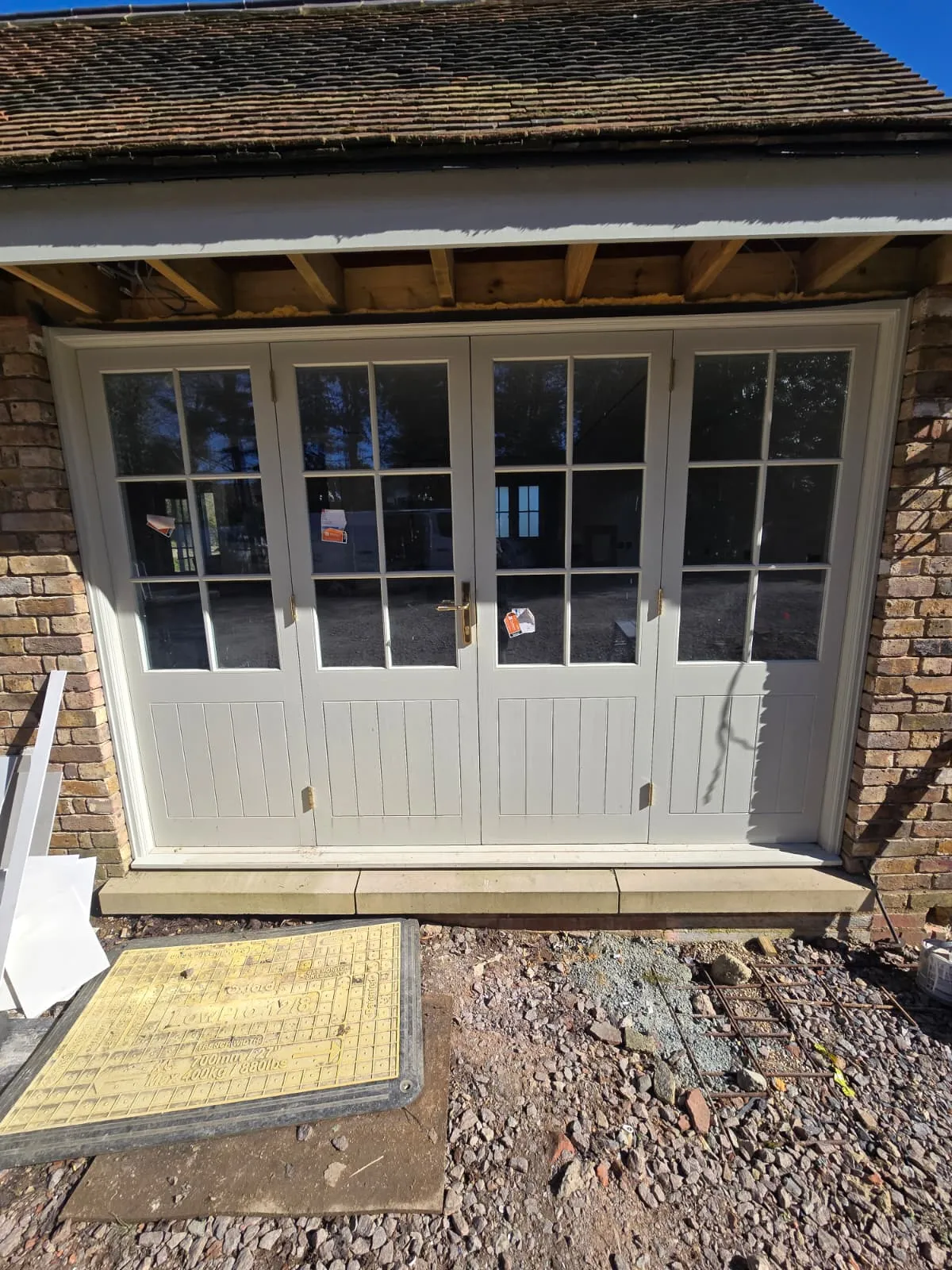
Bifold doors — fold to the side on a track; compromise between hinged and sliding. Useful for narrow alcoves where neither a full hinged swing nor a sliding panel is fully practical.
Specification
Timber and Finish
Painted softwood — the standard specification for fitted wardrobes in painted period rooms. Carcases in painted MDF or select softwood; door fronts in MDF or softwood; painted in any colour to match the room's existing joinery.
Shaker style — recessed panel doors in a painted finish; the most commonly requested style for London period bedrooms where a simple, unfussy aesthetic is the brief.
In-frame — a traditional frame-and-panel construction where the door sits within a face frame. The more elaborate construction suited to rooms with significant existing period joinery — cornices, panel walls — where the wardrobe needs to read as substantial furniture rather than fitted cabinetry.
Natural oak — for rooms where a natural timber grain is the brief. Clear European oak with an oil or hardwax finish; drawer fronts and door fronts grain-matched where possible.
Ironmongery
Handles, knobs and hinges are selected to match the style of the wardrobe and the room. Traditional brass cup pulls and knobs for period rooms; satin stainless or chrome bar handles for contemporary interiors; push-to-open mechanisms for handle-free doors.
Period Details
The finishing detail is what distinguishes bespoke joinery from fitted furniture. We match the existing room cornice — either by running new moulding to match, or by incorporating the existing cornice into the top of the wardrobe. Skirting boards are either mitre-returned at the wardrobe base or the plinth is designed as a continuation of the room skirting. Dado rails, where present, are either maintained below the wardrobe or the wardrobe door design incorporates a matching horizontal feature at the same height.
These are the details that make a fitted wardrobe look as though it belongs to the room rather than having been placed in it.
Frequently Asked Questions
Can you build into a Victorian alcove with uneven walls and sloping ceiling?
Yes — this is the most common brief we receive for London bedrooms. We take a full measured survey of the alcove including every variation in depth, width and height, and build the carcass to fit the space exactly. Uneven walls and sloping ceilings are not obstacles; they are normal conditions for this type of work.
How long does a fitted wardrobe take to install?
Manufacturing lead time is typically 4–6 weeks from specification approval. Installation of a pair of alcove wardrobes takes 1–2 days on site. A larger room with more complex storage takes longer.
Can you match the cornicing and skirting in the rest of the room?
Yes. We either run new moulding from the existing profile or source a matching profile from a specialist joinery supplier. If the existing moulding is unusual, we take a sample and have a matching cutter made. The finish coat — primer plus top coat — is specified to match the existing joinery colour.
How much do fitted wardrobes cost in London?
Cost depends on the size, specification, door type and internal configuration. We provide a detailed written quote after the survey and design stage, before any manufacturing begins.
Get a Free Survey
Contact us to arrange a free survey of your bedroom. We will measure the space, discuss the storage brief, and produce a design for your approval before manufacturing begins. We work across all London boroughs and respond to enquiries within 24 hours. For other bespoke joinery, see our bespoke furniture service and bespoke kitchens.

