
Bespoke Internal Doors in London
Internal doors in London period properties are a persistent problem. Victorian and Georgian door openings are almost never standard metric sizes. Decades of settlement leave openings that are out of plumb and out of square. Original doors are often missing, replaced with cheap flush units that look wrong, or cut down and rehung at odd heights. AMB Joinery manufactures bespoke timber internal doors in London — made to the exact dimensions of each opening, profiled to match existing originals, and finished to your specification.


Why London Period Properties Need Bespoke Doors
Off-the-shelf internal doors come in a limited range of standard sizes — typically 1981mm × 762mm, 838mm or 914mm wide. Victorian and Georgian properties routinely have openings at 1930mm, 2040mm or 2100mm high, and widths that fall between standard sizes. Trimming a factory door to fit reduces the structural integrity of the stile or rail and leaves an edge that must be re-lipped. The result rarely looks or feels right.
More importantly, off-the-shelf doors cannot replicate the profile details that define the character of a period interior. A Victorian four-panel door has specific stile widths, bottom rail heights, panel moulding profiles and bead details that vary between decades and between builders. In a corridor where existing original doors survive, a replacement that does not match stands out immediately.
AMB Joinery manufactures to the opening and to the profile. We can work from a physical sample of an existing door, from measured drawings, or from historic photographs where no original survives.
Door Types
Panelled Doors
The most common internal door type in London period properties. Victorian terraces typically feature a four-panel or six-panel arrangement; Georgian properties often have six or more raised-and-fielded panels. We manufacture in any configuration, matching the exact stile widths, rail heights, panel moulding profiles and bead details of the originals.
Glazed Internal Doors
Where natural light needs to pass between rooms — a hallway and a sitting room, or a kitchen and a rear reception — a glazed internal door is the correct solution. We can glaze with clear, frosted or decorative glass. Where fire rating is required (see below), safety glazing is specified as standard.
Ledged and Braced
Traditional ledged and braced doors — simple horizontal boards on a diagonal braced frame — are the correct type for utility spaces, cupboards, outbuildings accessed internally and cellar openings. We manufacture in softwood or hardwood depending on the application.
Flush Doors
Where a contemporary interior is the brief, flush timber doors — solid timber core with a veneered or painted MDF face — are available. We do not supply hollow-core doors.
Timber and Finish
Softwood (European Redwood) — the traditional and most cost-effective choice for painted internal doors. Finger-jointed or select grade; we recommend select grade for paint-grade doors that will be seen in detail.
Oak — for stained or oiled natural finishes. Clear oak with a tight grain takes a stain or oil finish very well; we can also supply character grade for a more rustic result.
Hardwoods — walnut, sapele, iroko and others are available for specific requirements.
Finishing — we supply doors primed and ready for the client's decorator, or fully painted in the specified colour. We do not supply unprimed bare timber for external-quality finishes.
Fire Doors
Where a fire rating is required — for HMOs and houses in multiple occupation, conversions, certain staircase enclosures and flats — we manufacture to FD30 and FD60 specifications. Fire door manufacture requires specific core construction, intumescent seals and compliant ironmongery; we handle all of this within our standard process. We will identify fire door requirements at survey stage.
Security
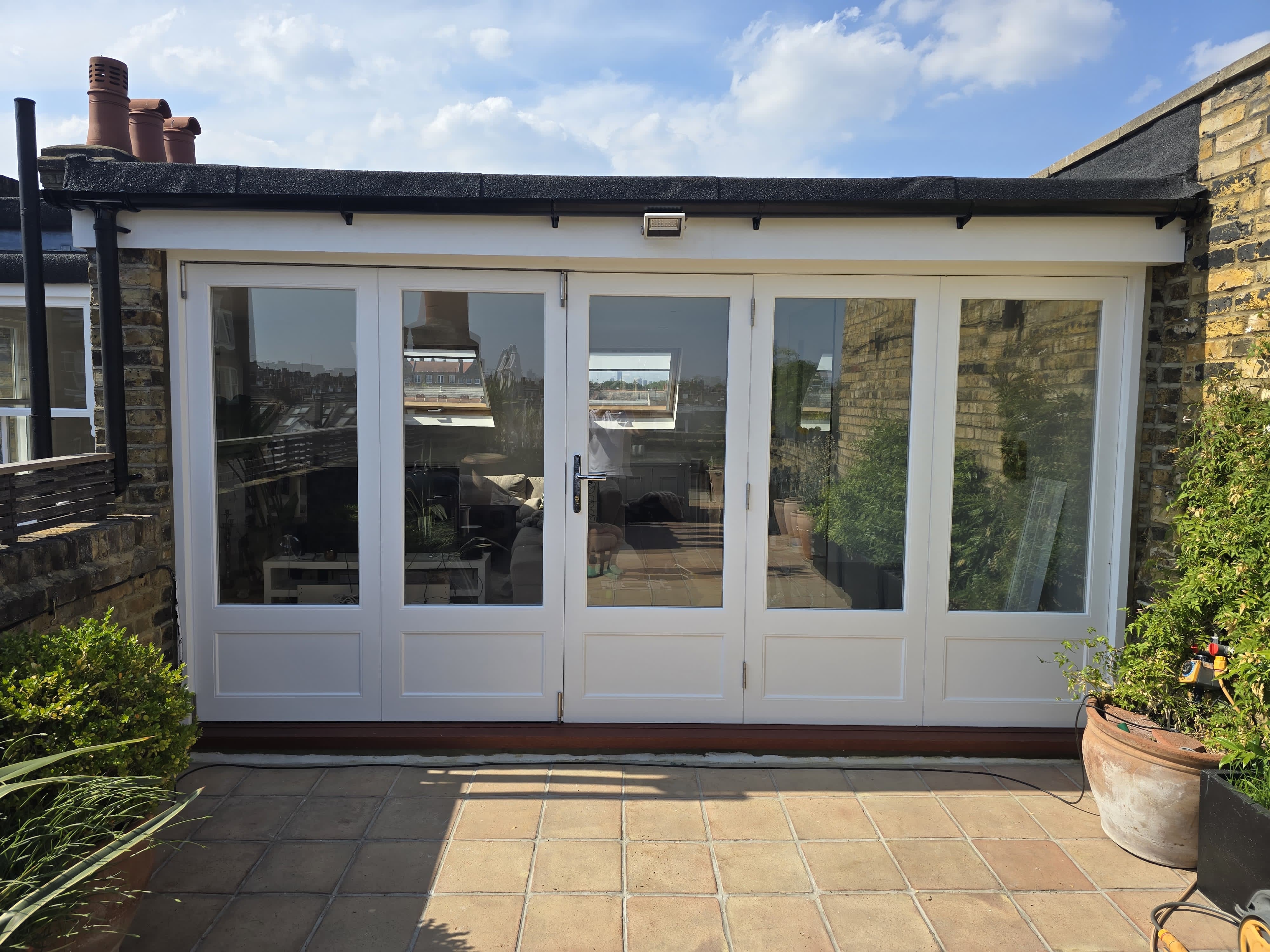
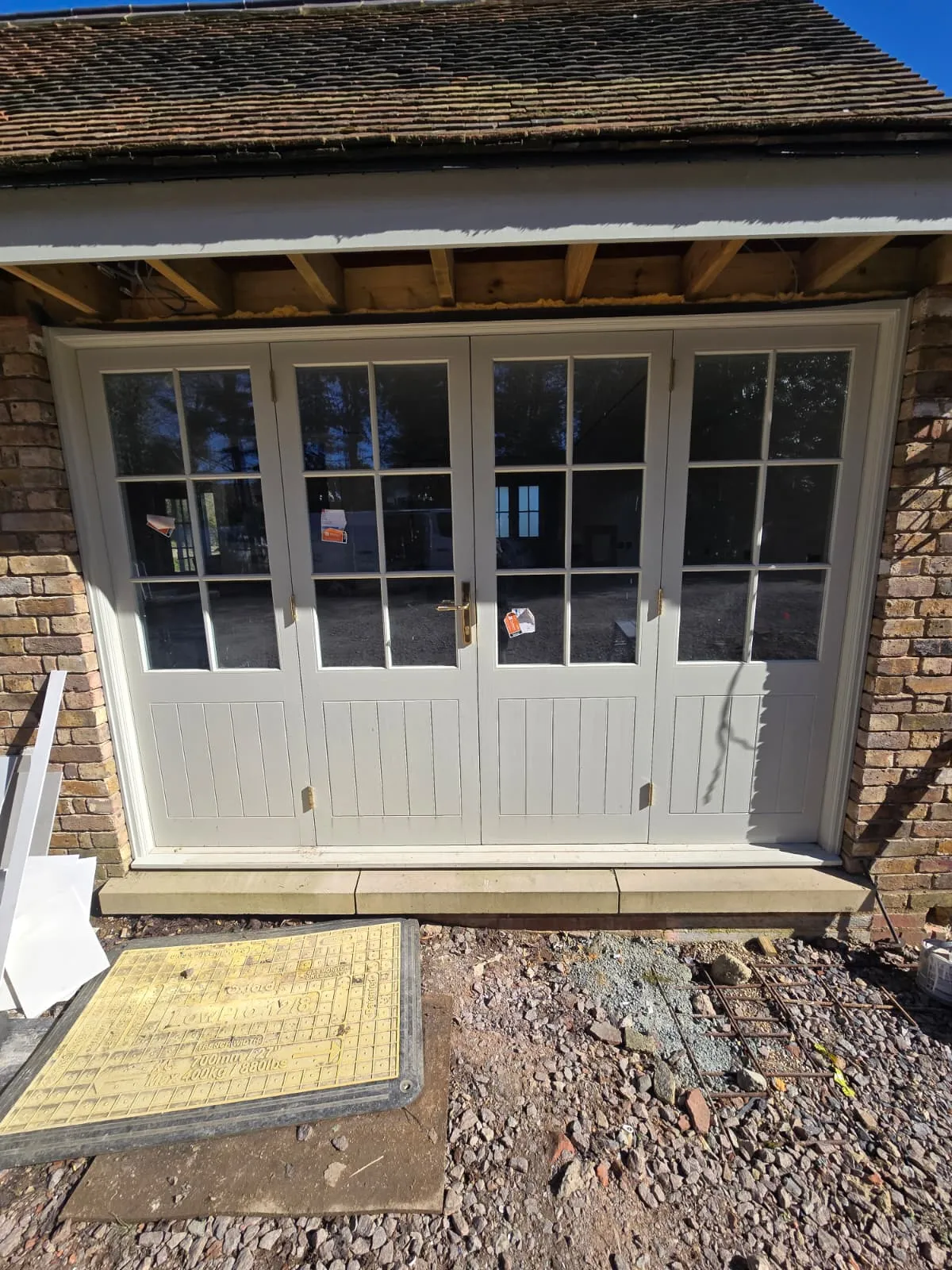
French doors are a common point of entry for burglars, principally because the astragal (meeting stile) can be attacked directly. We specify:
- Multi-point locking on each door — engaging the head and threshold in addition to the main latch
- Espagnolette bolts — vertical rods top and bottom on each door, engaging the frame at head and sill
- Anti-lift devices on the threshold track
- TS007-rated cylinder where a key cylinder is used
- Security hinges with non-removable pins
A correctly specified and installed pair of timber French doors is not a security weakness.
Ironmongery
We supply and fit all ironmongery as part of the installation:
- Hinges — solid brass, satin stainless or black-painted; matching the weight and size of the door
- Mortice latches and locks — traditional lever handles in period-appropriate finishes; modern lever or knob sets for contemporary interiors
- Bolts — bathroom and WC bolts where required
- Door stops — floor or wall-mounted
Where clients have specified their own ironmongery, we will fit it — but we request it be on site before installation begins so sizing and mortice positions can be confirmed.
Process
Survey
We measure every opening, assess conditions (plumb, square, any structural issues), and discuss profile requirements and finish
Specification approval
Drawings and a written specification for your approval before manufacture begins
Manufacturing
4–8 weeks from specification approval for bespoke doors
Installation
Doors hung, adjusted, ironmongery fitted and tested; linings and architraves made good as required
Frequently Asked Questions
Can you match my existing Victorian panel doors?
Yes. We take measurements and a profile sample from an existing door and replicate the stile widths, rail heights, panel moulding and bead details precisely. Where no original survives, we can work from period pattern books or historic photographs of the property.
What if my opening is a non-standard size?
Non-standard sizes are standard for us. Every door we make is manufactured to the specific dimensions of the opening. There is no premium for non-standard sizing.
What is the difference between a solid timber core and an engineered core?
A solid timber core door is made from a continuous block or laminated timber core — heavy, stable and very durable. An engineered core door uses a structural frame (typically softwood) with a cellular infill and a veneered or MDF face. Engineered core doors are lighter and more dimensionally stable in humid environments. For most internal applications, either is acceptable; for fire doors and very large doors, we specify solid or engineered solid depending on the fire rating required.
Do you supply fire doors?
Yes — FD30 and FD60. We identify fire door requirements at survey stage based on the property type and the position of the door within the building.
Get a Free Survey
Contact us to arrange a free survey of your internal doors. We work across all London boroughs and respond to enquiries within 24 hours. For external door work, see our bespoke external doors page. For wider joinery projects, see our bespoke furniture and joinery service.

