
Timber French Doors in London
Timber French doors — paired outward-opening casement doors, usually fully or substantially glazed — are one of the most common bespoke joinery requests in London period properties. They open a rear reception room onto a garden or terrace, replace a former window opening that has been enlarged, or provide access to a new rear extension. AMB Joinery manufactures bespoke timber French doors across London, made to the dimensions of each opening, matched to the character of the property and FENSA-certified where the work qualifies.


What Are French Doors?
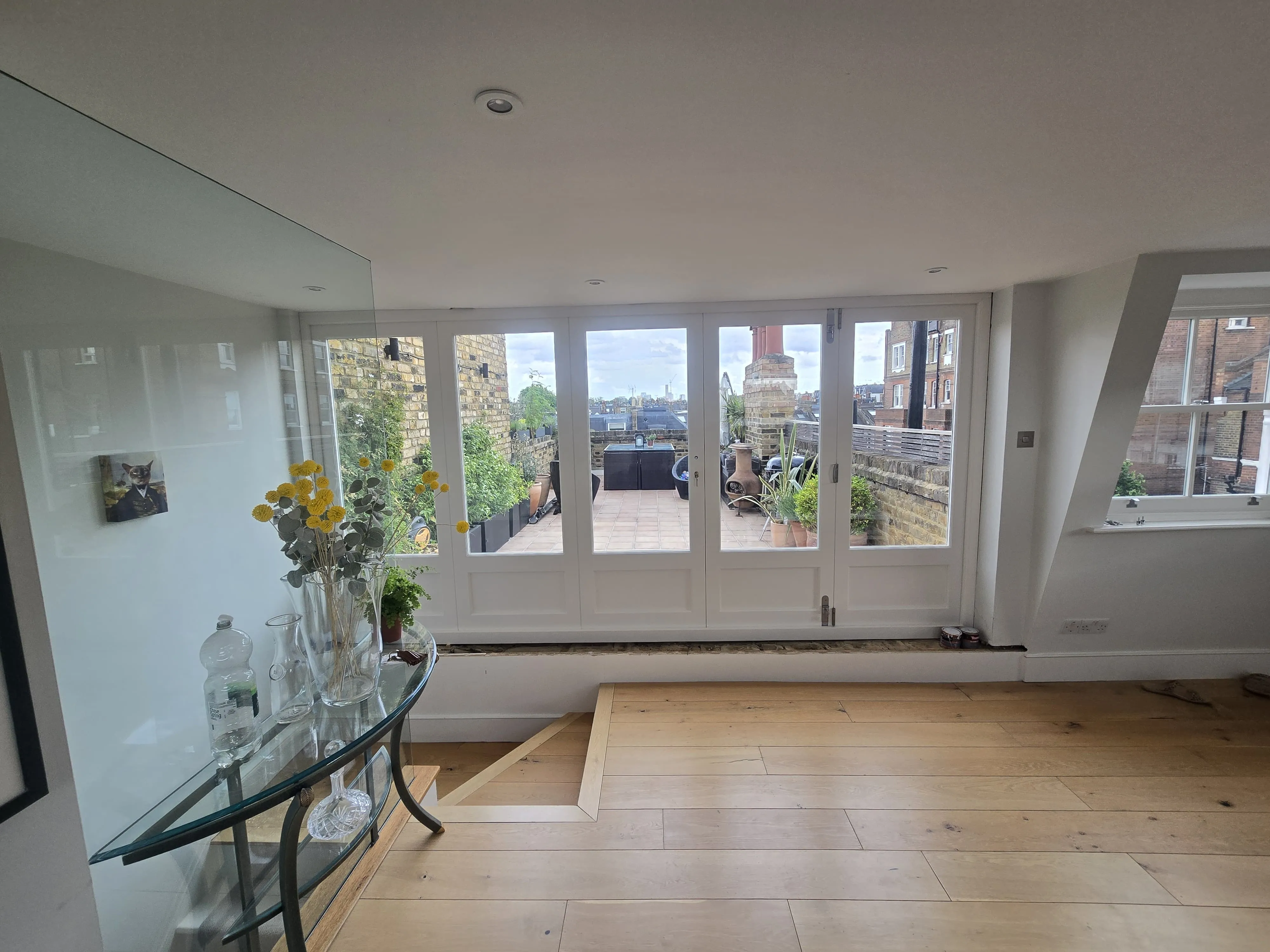
French doors are a pair of outward-opening hinged doors, typically glazed across most of their face, that operate together to create a wide opening. Unlike bi-fold doors, which fold concertina-style to stack to one side, French doors swing outward from the centre — requiring clear space in front of the opening. The classic configuration has a central astragal (the meeting stile where the two doors meet) and can be locked at the astragal and also at the top and bottom into the head and threshold.
The term is sometimes used loosely to describe any double garden door, but true French doors are hinged — not sliding, not folding.
Timber French Doors in Period Properties
French doors are architecturally appropriate in a wide range of London period properties — Victorian rear additions, Edwardian ground-floor reception rooms opening onto gardens, and inter-war properties with garden room openings. In most cases the best brief is to match the window style on the same elevation: if the windows are casements with ovolo-profiled glazing bars, the French doors should use the same profile and similar glazing bar configuration.
The key decisions are:
Glazed area and bar configuration
Fully glazed (maximum light), glazed with a kick panel at the bottom (more traditional, better for ground-floor security), or partially glazed with solid timber panels. The glazing bar pattern — single large pane, horizontal divided panes, or multi-light with glazing bars matching the windows — affects both the look and the amount of light admitted.
Opening direction
Outward-opening is standard and correct for most applications; it keeps the interior space clear. Inward-opening is available where the external threshold level makes outward opening impractical.
Threshold
The bottom rail and threshold detail is the most technically demanding part of a French door installation. We specify a low-profile threshold bar that provides weather exclusion without creating a trip hazard.
.webp)
Timber Species
Accoya is our standard recommendation for all French door installations. The paired configuration means two doors and a fixed frame meeting at very tight tolerances — seasonal movement in conventional softwood can cause the doors to stick or create draughts at the astragal. Accoya's dimensional stability eliminates this. It carries a 50-year above-ground durability guarantee and accepts paint exceptionally well.
European Oak — for natural hardwood finishes, oiled or waxed. The weight of a large oak French door requires robust hinges and a well-prepared structural opening.
Glazing
French doors are typically heavily glazed, which means glazing specification matters considerably.
- Standard double-glazed sealed units — argon-filled with a low-e coating; the most cost-effective specification for good thermal performance
- Acoustic laminated glazing — where the garden faces a busy road, railway or other noise source; the laminated pane significantly reduces sound transmission through the glazed area
- Toughened or laminated safety glass — specified as standard for all panels accessible from ground level; laminated is preferred for the lowest panels on security grounds
- Obscure glazing — available in a range of patterns for privacy without sacrificing light
All units meet the thermal performance requirements of Part L of the building regulations. All qualifying installations are FENSA-certified — see our FENSA compliance page.
Security
French doors are a common point of entry for burglars, principally because the astragal (meeting stile) can be attacked directly. We specify:
- Multi-point locking on each door — engaging the head and threshold in addition to the main latch
- Espagnolette bolts — vertical rods top and bottom on each door, engaging the frame at head and sill
- Anti-lift devices on the threshold track
- TS007-rated cylinder where a key cylinder is used
- Security hinges with non-removable pins
A correctly specified and installed pair of timber French doors is not a security weakness.
Planning Considerations
Replacing existing French doors — like-for-like replacement in a residential property is usually permitted development; no planning application required.
Enlarging an existing opening — any structural change to the opening size requires building control involvement; it may also require planning permission in conservation areas.
Listed buildings — any alteration to external doors requires Listed Building Consent.
Conservation areas with Article 4 Directions — a planning application may be required, particularly if the new doors are visible from the street. We establish the planning position during the survey.
French Doors vs Bi-Fold Doors
Both open a rear elevation to a garden or terrace. The choice depends on the opening size, the aesthetic brief and the practicalities of the space.
French doors work best for openings up to approximately 1800–2000mm wide. They are architecturally appropriate for period properties, require no track or folding mechanism, and the outward-opening configuration keeps the interior completely clear. The opening created is the full width of the door pair.
Bi-fold doors suit wider openings — typically 2400mm and above — and where a wider vista is the priority. They are mechanically more complex and more contemporary in character. For the comparison in detail, see our bi-fold doors page.
Frequently Asked Questions
How wide can timber French doors be?
A single pair of French doors can be manufactured up to approximately 1800–2000mm wide. For wider openings, a configuration with fixed side panels flanking the pair, or a switch to bi-fold doors, is more appropriate. We will advise during the survey.
Do French doors have to open outward?
Outward opening is standard and preferred for most applications — it keeps the internal floor area clear and avoids the issue of floor covering interfering with the door swing. Inward opening is possible where the external conditions require it, but drainage at the threshold becomes more complex.
Do I need planning permission for French doors?
For a like-for-like replacement in a standard residential property, no. For enlarging the opening, in conservation areas, or in listed buildings, yes — the requirements depend on your specific situation. We establish this at survey stage.
Can French doors be double glazed in a conservation area?
In most conservation areas, yes. Slim sealed units within timber frames are generally acceptable. For the most restrictive listed building contexts, Fineo vacuum glazing is the correct specification.
Get a Free Survey
Request a free survey and we will assess the opening, establish the planning position and provide a detailed written quote. We work across all London boroughs and respond to enquiries within 24 hours. For wider openings, see our bi-fold doors page. For general external door information, see our external doors page.

