
Timber Bi-Fold Doors in London
Timber bi-fold doors are increasingly common in London rear extensions and ground-floor garden openings — a way to open a wide rear elevation fully to an outdoor space without the fixed frame of a traditional door arrangement. AMB Joinery manufactures bespoke timber bi-fold doors in London, made to measure for each opening, specified for London's climate and planned around the thermal, security and planning requirements of each project.
We do not install aluminium or uPVC bi-fold doors.


How Bi-Fold Doors Work
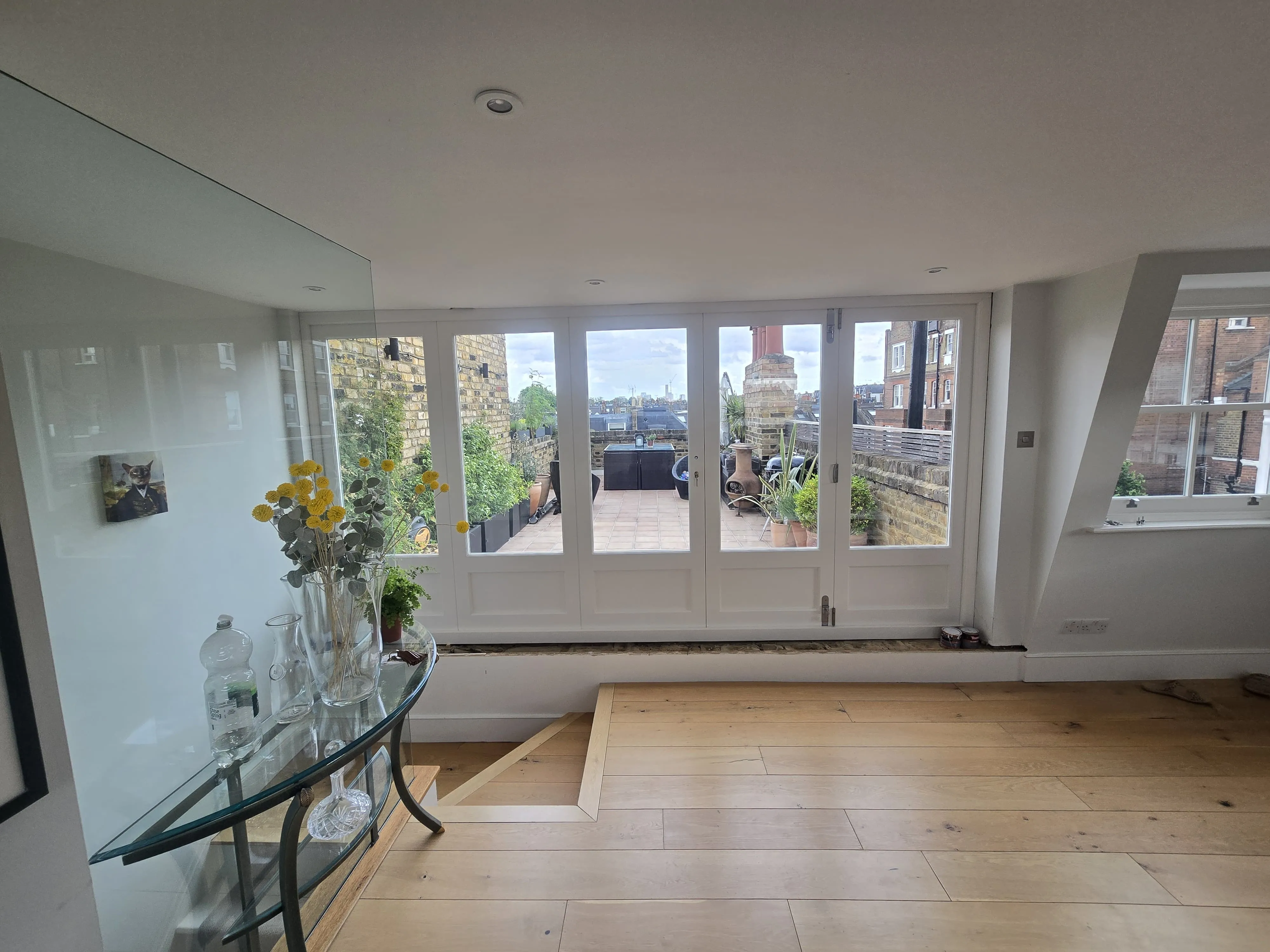
Bi-fold doors consist of a series of panels — typically three to six — connected by hinges and suspended from a top track. When opened, the panels fold concertina-style and stack to one or both sides of the opening, leaving the full width of the aperture clear. The result is a much wider clear opening than a pair of French doors can provide from the same total frame width.
The operating hardware — track, hinges, handles and locking — is more complex than a standard hinged door. The quality of that hardware determines how well the doors perform over the long term: cheap track systems wear, misalign and become difficult to operate within a few years.
Timber Bi-Fold Doors vs Aluminium
The majority of bi-fold doors installed in London are aluminium. Aluminium's narrow frame sections and factory powder-coat finish have made it the default specification for modern extensions. It is not, however, the only correct choice — and for period properties, rear extensions to Victorian and Edwardian houses, and any property where the planning authority is involved, timber is often a better fit.
Read More
Timber bi-fold doors have wider frame sections than aluminium, which affects the visual proportion of the glazing. They suit larger panes and fewer panels better than very narrow aluminium sections do. For a rear extension to a Victorian terrace where the existing windows and doors are timber, timber bi-fold doors read as part of the same architectural language; aluminium does not.
AMB Joinery manufactures timber bi-fold doors in Accoya — the correct specification for an externally exposed timber door that needs to perform reliably without seasonal swelling or shrinkage.
.jpeg)
.webp)
Timber Species
Accoya — the only species we recommend for bi-fold door applications. Bi-fold doors are mechanically complex: the panels fold and unfold thousands of times a year, the tolerances between panels are tight, and the panels are heavily exposed to weather. Seasonal movement in conventional softwood causes bi-fold panels to swell in winter, jamming the track, and to shrink in summer, creating draughts. Accoya's dimensional stability eliminates both problems. It carries a 50-year above-ground durability guarantee.
We do not recommend European Redwood for bi-fold doors in exposed positions.
Glazing
Bi-fold doors are typically heavily glazed — the purpose is to bring light and connection to the garden, so minimal framing and maximum glass is usually the brief.
- Standard argon-filled double-glazed units with low-e coating — the baseline specification; good thermal performance
- Acoustic laminated glazing — for gardens backing onto roads, railway lines or where the outdoor noise environment makes acoustic performance relevant
- Solar control coatings — for south-facing openings where summer overheating is a risk
- Toughened or laminated safety glass — specified as standard for all panels; laminated preferred on security grounds for the lower panels
All units meet Part L building regulations thermal requirements. All qualifying installations are FENSA-certified — see our FENSA compliance page.
.jpeg)
Configuration Options
Number of panels
Three to six panels are the most practical range for timber bi-fold doors. Fewer panels mean wider individual panels (better thermally, simpler mechanically); more panels mean a narrower stack when open. We advise on the optimal configuration for each opening width.
Opening direction
Panels can stack to the left, to the right, or split to both sides. Split configuration (equal numbers of panels folding to each side) is the most balanced option for wide openings.
Traffic door
One panel in the set can be specified as a traffic door: it opens independently on a standard hinge, allowing normal access without folding the entire set.
Threshold
A a flat low-profile threshold is standard; fully flush (level access) thresholds are available and required for some planning permissions and for accessibility.
Security
Bi-fold doors require specific security measures:
- Multi-point locking on each door panel — engaging at top and bottom into the head and sill
- Anti-lift devices preventing panels from being lifted off the track
- Shoot bolts into the frame at the hinge side
- Laminated safety glass in the lower panels
A correctly specified timber bi-fold door is not a security compromise compared with a traditional hinged door.

Planning Considerations
Bi-fold doors are most often installed as part of a rear extension — in which case the planning position for the extension governs the whole project, including the doors. For existing rear openings being enlarged:
- Structural changes to the opening always require building control involvement
- Planning permission may be required in conservation areas for changes visible from the street (rear extensions visible over a low boundary, for example)
- Listed buildings require Listed Building Consent for any external alteration
We coordinate with the structural engineer and planning consultant where required, and advise on the planning position for each project during the survey.
Bi-Fold vs French Doors
The choice between French doors and bi-fold doors usually comes down to opening width and architectural character.
French doors
Are correct for openings up to approximately 1800–2000mm, for period properties where the outward-opening hinged configuration is architecturally appropriate, and where the mechanical simplicity of hinged doors is preferred. They open to the full width of the door pair and require no track.
Bi-fold doors
Are better suited to wider openings — 2400mm and above — where the goal is a panoramic connection to the garden and where the contemporary character of a folding door system fits the architectural brief.
Frequently Asked Questions
Can timber bi-fold doors be installed in an existing opening?
Yes, if the opening is structurally adequate for the span. Widening an existing opening requires a structural engineer's specification and building control sign-off. We will advise on the structural requirements during the survey.
How many panels should I specify?
For most domestic openings (2400–4000mm), three or four panels is the most practical range. Wider openings can use five or six panels. The key trade-offs are: fewer panels = better thermal performance and simpler operation; more panels = narrower stack when open. We advise based on the specific opening.
Do timber bi-fold doors stick in winter?
Not when manufactured in Accoya. Conventional softwood bi-fold doors are prone to seasonal swelling in wet winters, which causes the panels to jam in the track. Accoya's dimensional stability eliminates this.
Do I need planning permission for bi-fold doors?
For a like-for-like replacement in an existing opening in a standard residential property, usually no. For enlarging the opening, in conservation areas or in listed buildings, the planning requirements are more complex. We establish the position during the survey.
Get a Free Survey
Request a free survey and we will assess the opening, advise on configuration, establish the planning and structural position, and provide a detailed written quote. We work across all London boroughs and respond to enquiries within 24 hours. For narrower openings, see our French doors page. For general external door information, see our external doors page.

